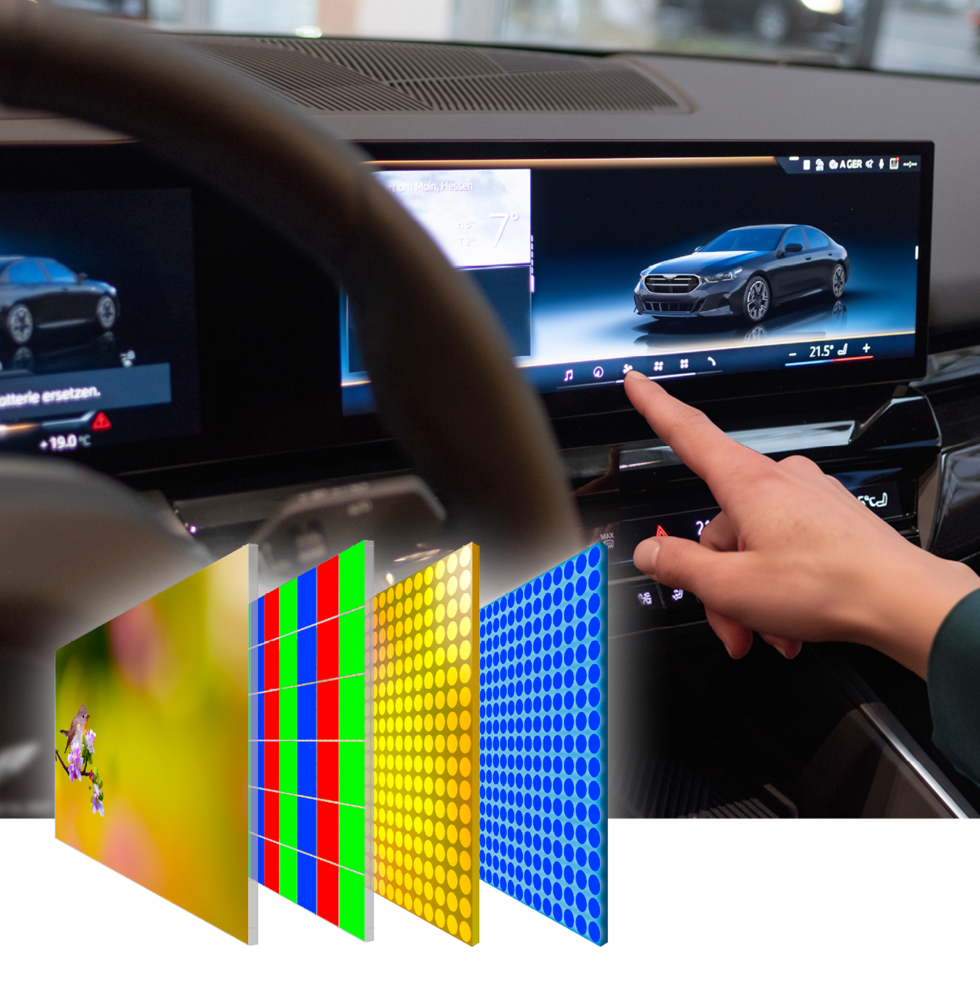
Increasing demands for color accuracy, energy efficiency, and form factor optimization continue to drive innovation in display technology. One technology is at the forefront of this progress: quantum dots. These nanoscale semiconductor nanocrystals open up new dimensions in color reproduction and are becoming a decisive factor for the next generation of displays—from industrial panels and automotive clusters to medical applications.
Precise Color Control Through Nanostructure
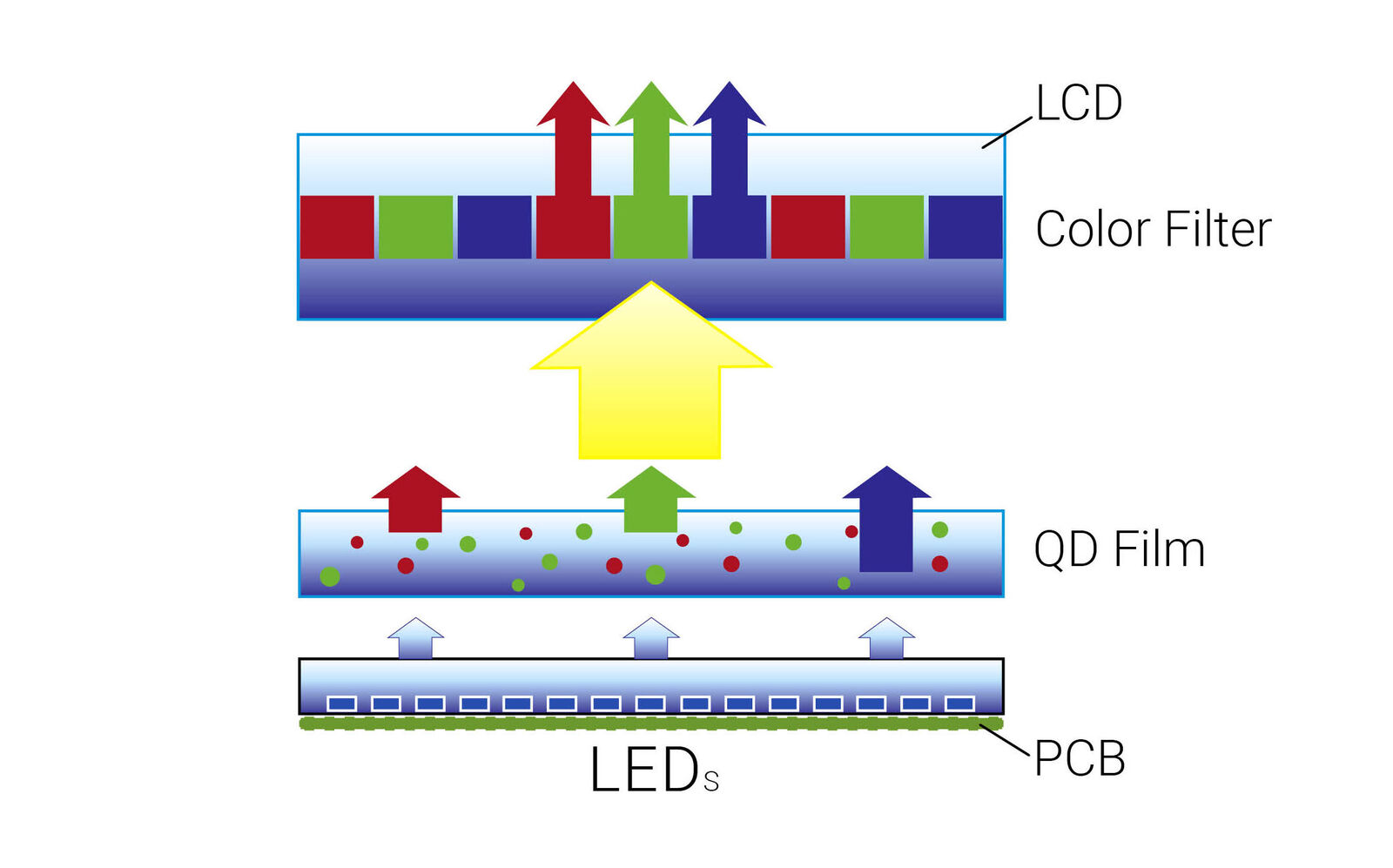
Quantum dots are characterized by size-dependent optical properties: the emitted wavelength—i.e., the perceived color—is precisely defined by the particle diameter. This quantum-mechanical tunability enables highly accurate spectral conversion of the LED backlight.
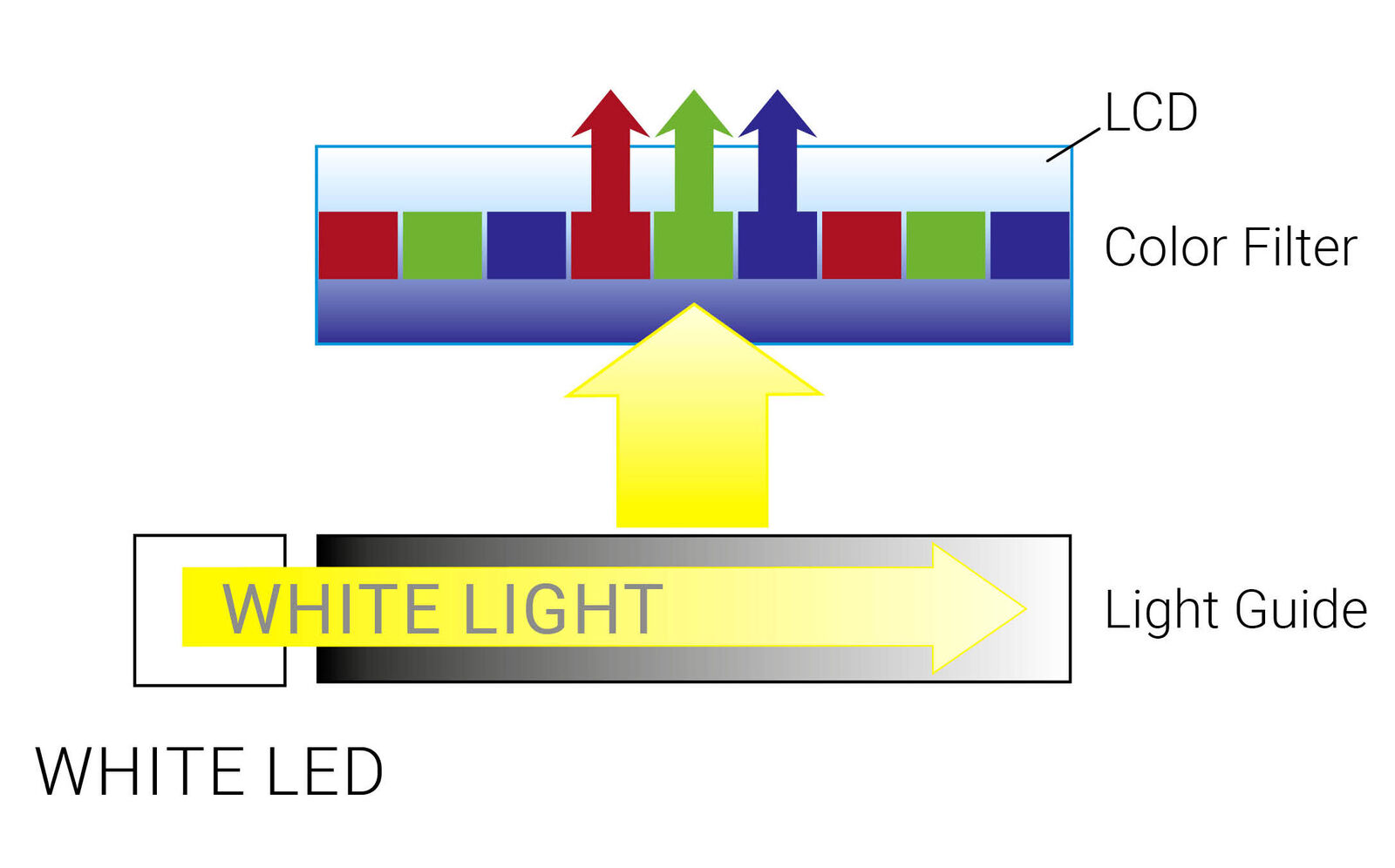
Blue LEDs are preferred over white LEDs, as quantum dots function as photoluminescent converters. They efficiently absorb short-wavelength, high-energy blue light and selectively convert it into narrowband red and green emission. In contrast, white LEDs rely on broadband phosphor conversion, which is spectrally less precise and introduces unnecessary optical losses. Direct excitation with blue light therefore enables significantly improved spectral control and higher conversion efficiency.
Modern quantum dot displays already achieve more than 90% coverage of the BT.2020 color space—an essential advantage in applications where color fidelity and image consistency over the entire product lifetime are critical performance parameters.
Two technical approaches currently dominate development:
Quantum-Dot LCD (QD-LCD): Blue LEDs excite quantum dots that emit red and green light.
Quantum-Dot Electroluminescence (QD-EL): Each pixel acts as an active light source—the next generation of self-emissive displays, with market maturity expected around 2030.
Key Characteristics of Quantum Dots
Particle size: 2–10 nanometers
Materials: CdSe/ZnS, InP, perovskites
Emission: Wavelength controllable via particle size
Quantum dot technologies are already established across multiple industries:
Industrial applications: Displays with high color stability and extended operational lifetime—ideal for control and measurement systems in continuous operation.
Consumer electronics: Televisions, HDR monitors, high-end gaming displays, tablets, and smartphones benefit from improved battery life and brilliant color reproduction.
Automotive: High luminance and contrast performance for infotainment and cockpit displays—even under direct sunlight.
Medical technology: Precise color reproduction for diagnostic and visualization systems.
AR/VR and emerging form factors: Flexible or transparent displays benefit from the high luminous efficacy and minimal layer thickness of quantum dots.
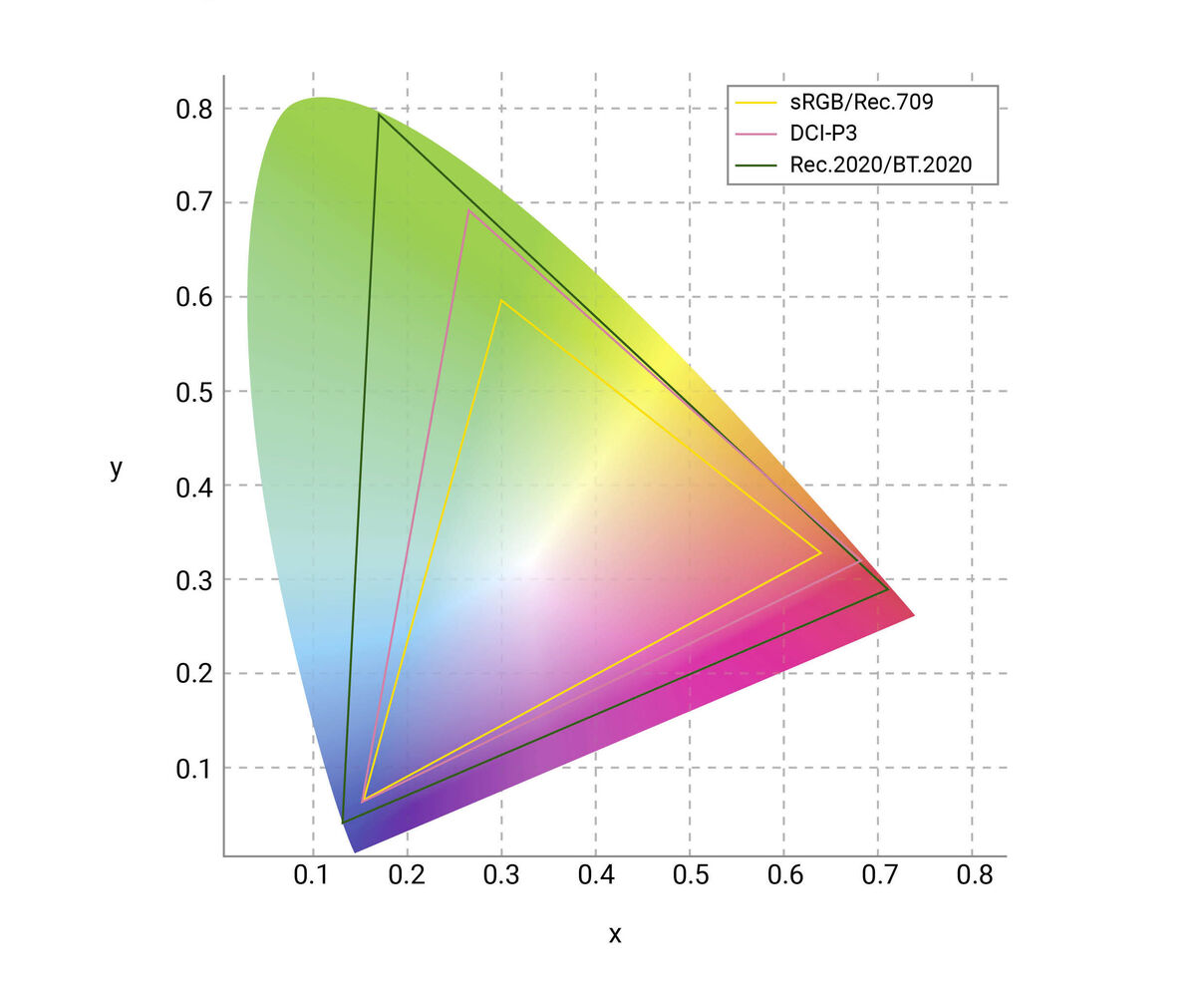
Comparison of Color Spaces: sRGB, DCI-P3, and BT.2020 (Image: BECK Elektronik)
sRGB / Rec.709: The smallest current standard for web and HDTV applications.
DCI-P3: Extended color space used in digital cinema and HDR displays.
BT.2020 (Rec.2020): Target standard for UHD and 8K systems.
Quantum dot displays are engineered to cover large portions of DCI-P3 and, in the long term, also BT.2020.
Quantum Dots Combined with Mini-LED: A Technological Leap in Contrast and Efficiency
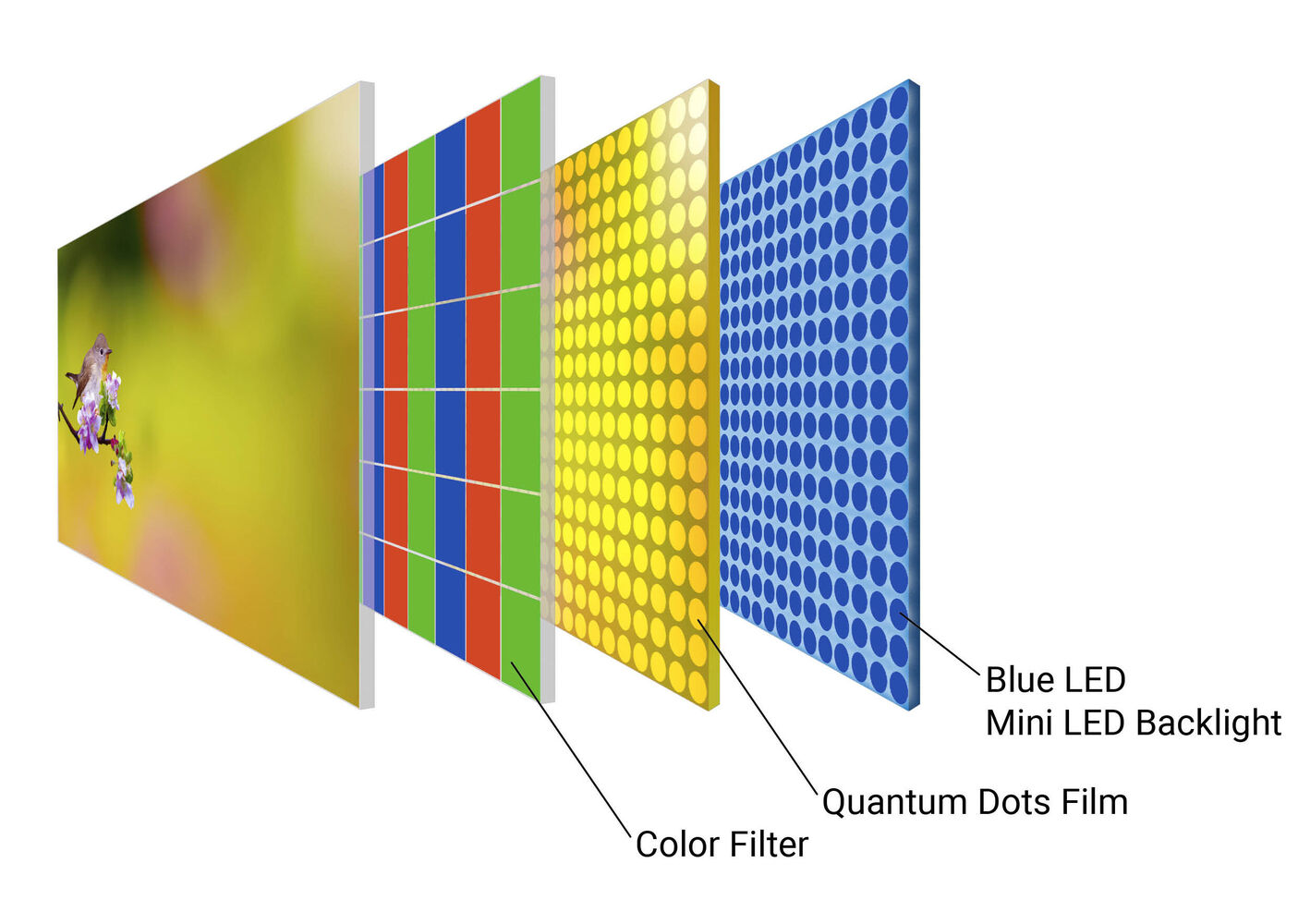
A significant advancement is achieved by integrating quantum dots with Mini-LED backlighting systems. By subdividing the backlight into finely graduated brightness zones, substantially higher contrast ratios can be realized.
Systems featuring more than 5,000 local dimming zones enable adaptive brightness control at a granular level. This not only reduces power consumption but also ensures precise rendering of both dark and bright image regions.
Structure of a display with Mini-LED and quantum dot technology (Image: BECK Elektronik)
Our partner Innolux is among the technological leaders in this field. The company develops active-matrix Mini-LED backlight systems that enable precise local dimming and uniform light distribution. To support this functionality, Innolux has designed dedicated integrated circuits capable of analyzing image content in real time, thereby optimizing color reproduction and contrast performance.
Initial mass-production models are already available:
Manufacturer designation
Size (cm)
Brightness (min., cd/m²)
Resolution
Dimming zones
Contrast (min.)
NTSC
Interface
Touch
ZD070VA-01A
17.8 (7.02")
1.690
1200 × 1920
384
40.000:1
90%
MIPI
In-Cell
ZD070VA-01B
17.8 (7.02")
1.512
1200 × 1920
384
40.000:1
90%
MIPI
In-Cell
HK110VA-01A
27.8 (10.95")
1.600
1200 × 2000
384
20.000:1
90%
MIPI
In-Cell
GK133VB-01A
33.8 (13.30")
1.300
3840 × 2160
960
12.000:1
96%
eDP
n/a
GK173VB-01B
43.9 (17.30")
1.300
3840 × 2160
1.440
12.000:1
100%
eDP
n/a
Experience It Live at embedded world 2026
At embedded world 2026, we will present a selection of quantum dot and Mini-LED displays from Innolux in standard industry sizes, specifically engineered for demanding industrial, automotive, and medical applications.
Our technical sales team will support you in selecting suitable panels, adapting them to project-specific requirements, and integrating them into existing system architectures.
Essenzielle Cookies sind für den Betrieb der Website unbedingt erforderlich und können daher nicht deaktiviert werden. Diese Cookies speichern keinerlei persönliche Informationen.
Cookie-Informationen
Cookie-Consent-Cookie
Zweck
Dieses Cookie wird benötigt, um die von Ihnen getroffene Auswahl der erlaubten Cookies zu speichern.